Argentine Banks Test JPMorgan's JPM Coin for Faster Interbank Settlement


Argentine banks including Banco CMF have begun piloting JPMorgan's deposit token JPM Coin to test improvements in interbank settlement and reconciliation. The tests use no real funds and operate within existing central bank restrictions.
Quick Insights
- A group of Argentine banks is piloting JPMorgan's deposit token JPM Coin to test improvements in interbank settlement speed and reconciliation.
- Banco CMF is a confirmed participant, operating through its corporate unit QORP. Banco Galicia, BIND, and Banco Comafi are reportedly considering joining.
- The tests use no real funds. Transactions settle through traditional systems while blockchain records and reconciles the operations alongside.
A group of Argentine banks has begun testing JPMorgan's deposit token infrastructure for back-end settlement, according to a report from local outlet iProUP. The pilot focuses on using JPM Coin, a USD-denominated deposit token designed for institutional use, to improve the speed and accuracy of interbank reconciliation.
Banco CMF is among the confirmed participants, working through its newly launched corporate unit QORP as part of what JPMorgan has structured as a minimum viable product phase. The tests are being conducted without moving real funds. Transactions are settled through traditional systems while the blockchain layer records and reconciles the same operations in parallel, providing a direct comparison of processing times.
"In the first phase, banks are expected to work on integrating available services to verify improvements in settlement times and interbank reconciliations of integrated banks."
Industry sources cited by iProUP suggest several other lenders are considering joining the programme, including Banco Galicia, BIND, and Banco Comafi. If those institutions participate, the pilot would cover a broader cross-section of Argentina's private banking sector.
Argentina's Central Bank Still Bans Crypto Services, But Not Internal Blockchain Use
The timing adds a layer of complexity. Argentina's central bank, the Banco Central de la República Argentina (BCRA), issued Communication A 7506 in 2022, barring financial institutions from offering crypto-related services to their customers. That restriction remains in place as of April 2026, though the BCRA is reportedly reviewing whether to amend or lift it.
The JPM Coin pilot does not violate the existing rule because it involves internal infrastructure rather than client-facing crypto services. The banks are not offering crypto products to customers. They are testing whether a deposit token can improve the mechanics of how they settle transactions with each other behind the scenes. That distinction, internal use of blockchain versus offering crypto to clients, is what allows the tests to proceed under current regulations.
JPM Coin (ticker: JPMD) is a USD-denominated deposit token issued by JPMorgan. Unlike stablecoins, it represents a direct claim on deposits held at the bank. It launched on the Coinbase-developed Layer 2 network Base in November 2025, following trials with Mastercard, Coinbase, and B2C2. In January 2026, JPMorgan expanded JPM Coin to the Canton Network, a privacy-focused blockchain backed by Goldman Sachs and Citadel. The token is designed for institutional clients only and enables near-instant, 24/7 settlement of wholesale payments.
JPM Coin Is Expanding Globally While Most People Haven't Heard of It
The Argentine pilot is part of a broader expansion of JPM Coin beyond the U.S. market. JPMorgan's blockchain division, Kinexys, has been pushing the deposit token across multiple blockchain networks throughout 2026, with plans to add euro and pound-denominated versions over time.
The token currently operates on Base and the Canton Network, and JPMorgan has indicated it intends to expand to additional blockchains. Institutional clients including Siemens already use JPMorgan's Kinexys Digital Payments network for near-instant cross-border FX payments, and JPM Coin extends that capability onto public blockchain rails. Naveen Mallela, co-head of Kinexys, has described the strategy as building "regulated, interoperable digital money" that can move across financial markets around the clock.
The fact that Argentine banks are testing this infrastructure is notable not because of the scale of the pilot, which is small and uses no real capital, but because of what it implies about where institutional blockchain adoption is heading. JPM Coin is no longer a proof of concept confined to JPMorgan's own client base. It is being tested by third-party banks in emerging markets as a potential upgrade to their own settlement workflows.
Latin America's $1.5 Trillion Crypto Market Provides the Context
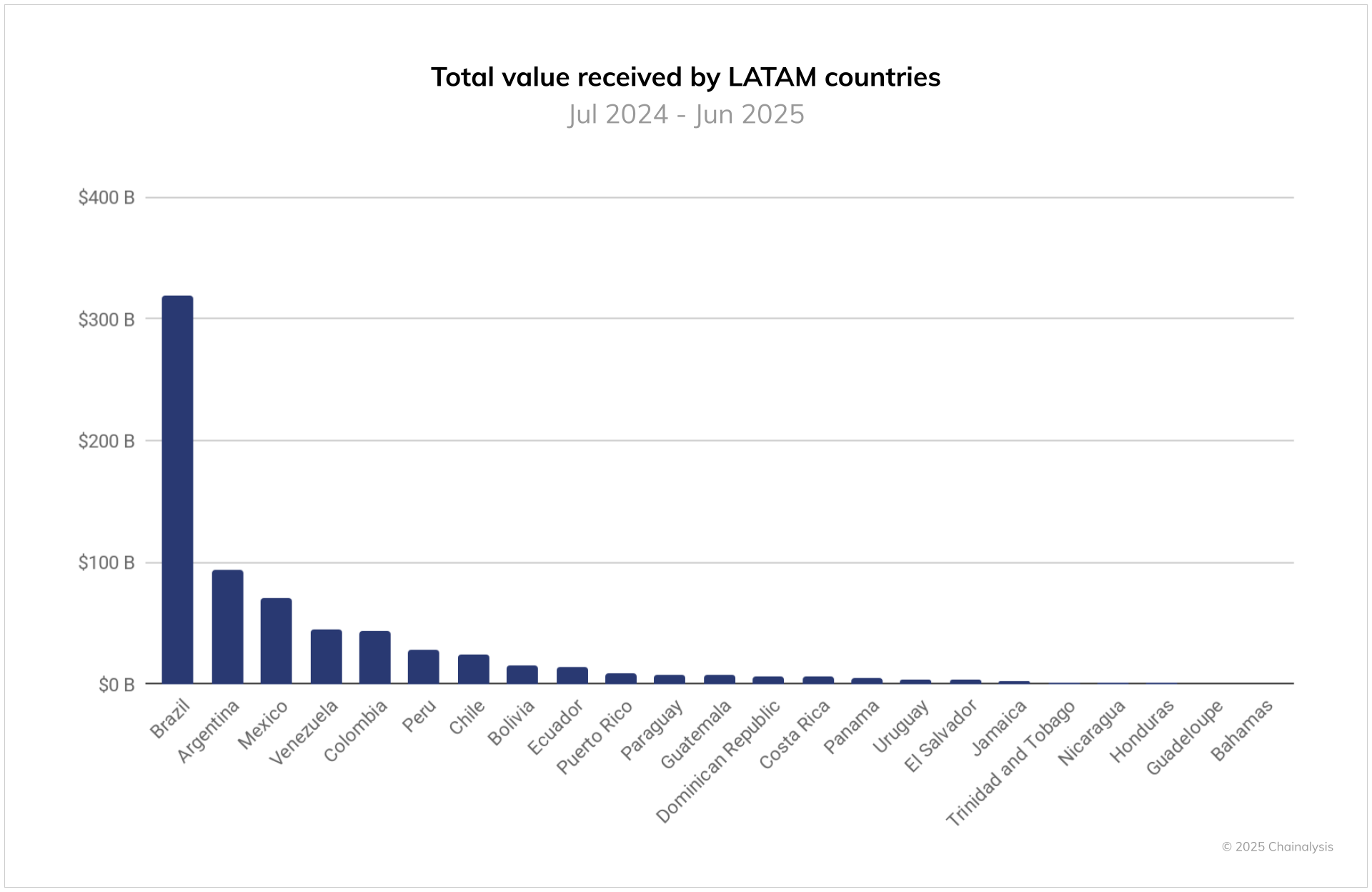
Argentina's banking sector is exploring this infrastructure against a backdrop of rapid crypto growth across the region. Latin America recorded nearly $1.5 trillion in crypto transaction volume between mid-2022 and mid-2025, with monthly activity peaking at $87.7 billion in December 2024, according to Chainalysis data.
Brazil led the market by a significant margin, accounting for roughly one-third of regional activity, with Argentina and Mexico following behind. Argentina's own crypto adoption has been driven in part by persistent inflation and currency instability, which have pushed both retail and institutional participants toward dollar-denominated digital assets as a practical hedge.
The JPM Coin pilot fits into that broader pattern. Argentine banks are not adopting blockchain because it is new. They are testing it because the existing settlement infrastructure in the region is slow and expensive, and tools like deposit tokens offer a measurable improvement. Whether the BCRA eventually loosens its restrictions to allow client-facing crypto services will determine how far this goes. For now, the back-end testing is proceeding within the rules as they stand.


