Iran's Military Now Runs 70% of Its Bitcoin Mining Operations

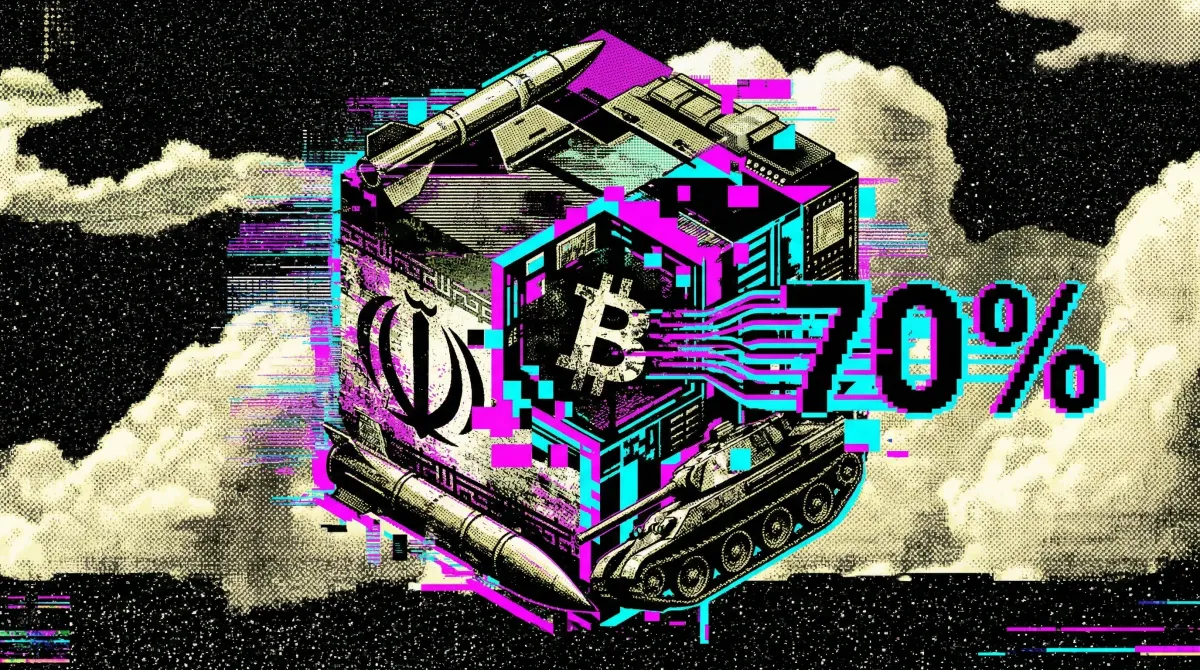
Iran now accounts for 6-8% of global Bitcoin hashrate, with the IRGC running roughly 70% of operations. US-Israeli strikes on energy infrastructure have since knocked 100 EH/s off the network.
Quick Insights
- Iran contributes an estimated 6-8% of global Bitcoin hashrate, making it one of the largest mining nations in the world.
- Roughly 70% of the country's mining operations are conducted by or linked to the Islamic Revolutionary Guard Corps (IRGC).
- Recent US-Israeli military strikes have disrupted Iran's energy grid, contributing to a 100 EH/s drop in global hashrate since late February.
Iran has quietly built one of the biggest Bitcoin mining operations on the planet, and the country's military is running the bulk of it. Data circulating this week suggests Iran accounts for 6-8% of global Bitcoin hashrate, with approximately 70% of that mining activity conducted by the IRGC or entities linked to it.
The country legalised crypto mining in 2019, allowing licensed operators to use subsidised electricity in exchange for selling mined BTC to the central bank. That arrangement turned cheap domestic energy into hard currency that could move across borders without touching the US dollar system. Under a 2022 agreement between the Ministry of Industry and the central bank, mined Bitcoin can be used directly to pay for imports.
How Iran Turned Subsidised Power Into Sanctions-Proof Revenue
The Iranian state is believed to mine BTC at roughly $1,300 per coin, then sells or uses it at market prices. For a country cut off from the global banking system, that's an effective workaround.
But the licensed mining sector only tells part of the story. Iran's unlicensed mining operations, drawing power from unmetered residential and commercial lines, are believed to be significantly larger than what appears in official data. When Iranian hashrate dropped to near zero in some Western datasets around 2022, analysts noted that miners likely routed traffic through offshore proxies rather than actually shutting down.
Chainalysis estimates that IRGC-linked addresses accounted for more than 50% of total Iranian crypto inflows in the final quarter of 2025, with over $3 billion in value received last year.
The Strikes Changed the Equation
The US-Israeli military campaign that began on February 28 hit Iran's energy infrastructure directly. Oil depots, refineries, and storage facilities across multiple provinces took damage, introducing grid instability that forced emergency load-shedding across industrial users.
For Bitcoin mining, the impact was immediate. Global hashrate peaked near 1,083 EH/s on March 1 and fell to roughly 937 EH/s within weeks, a decline of more than 100 EH/s. Analysts at Blockspace and Luxor Technologies have linked part of the drop to disruptions in Iran and the broader Gulf region, though US weather events also contributed.
Bitcoin's mining difficulty responded with a 7.7% downward adjustment, one of the largest this year and among the steepest since the China mining ban in 2021.
What It Means for Bitcoin's Network
The reaction on crypto X has been split.
Some see Iran's mining share as evidence that Bitcoin is becoming a geopolitical tool for sanctioned states. Others point out that even if a nation controls a meaningful slice of hashrate, it still doesn't control Bitcoin. Hashrate can concentrate geographically for a period, but protocol rule changes still require global consensus.
The more practical concern is what happens if Iran's grid stays under pressure. CoinDesk reported that military strikes targeting energy infrastructure could eliminate 30-50% of Iran's electricity production, which would halt national mining operations. The global network would adjust through difficulty recalibration, but the short-term hashrate volatility is already visible in the data.
For Iran, the stakes go beyond mining economics. Bitcoin has become a core piece of the country's sanctions evasion infrastructure. Losing mining capacity doesn't just mean lost revenue. It means losing one of the few remaining channels for moving hard currency across borders.
