MemeCore's M Token Crashes 74% With No Catalyst as ZachXBT Presses Exchanges Over Listings

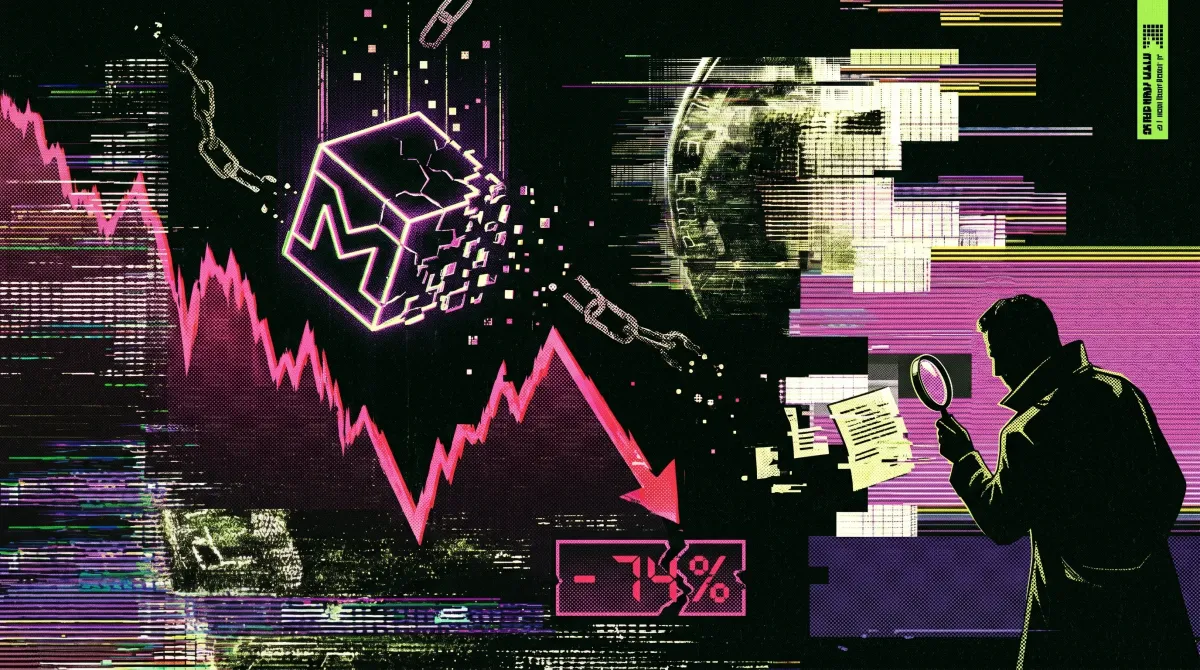
MemeCore's M token crashed 74% on Thursday with no confirmed catalyst, reigniting questions ZachXBT raised in April about insider supply concentration and exchange listing standards.
Quick Insights
- MemeCore's M token fell roughly 74% in 24 hours on Thursday, dropping from a high of $2.92 to as low as $0.50 before steadying around $0.74, with no exploit, hack or announcement to explain the move.
- The collapse wiped close to $3 billion in market value, pushing M's market cap below $1 billion on daily trading volume of just $21 million — thin relative to the size of the move.
- On-chain investigator ZachXBT, who raised concerns about M in April over insider supply concentration and suspicious exchange flows, renewed pressure on Kraken, Bitget and Binance over their listing decisions following the crash.
MemeCore's M token lost roughly three-quarters of its value on Thursday, collapsing from a 24-hour high of $2.92 to an intraday low of $0.50 before recovering slightly to around $0.74. No confirmed exploit, hack or team announcement preceded or accompanied the move. Daily trading volume was approximately $21 million — thin for a token that had recently carried a multi-billion dollar market capitalisation — suggesting the selling pressure was not absorbed by any meaningful liquidity base beneath the market price.
The fall erased close to $3 billion in market value. Before the slide, M carried a market cap of roughly $3.8 billion. By Thursday morning it had dropped to around $940 million according to CoinGecko, pushing the token from the top 20 largest cryptocurrencies to 72nd by market cap. Altcoins with concentrated insider supply and thin real liquidity are particularly vulnerable to collapses of this speed and scale, as there are few natural buyers to slow the move once selling accelerates.
ZachXBT Flagged the Token in April and Is Now Pressing Kraken Bitget and Binance
The crash reignited concerns that onchain investigator ZachXBT had raised publicly two months earlier. In an April post on X, he questioned how M had cleared due diligence when Kraken listed it for spot trading in July 2025, alleging that insiders had manipulated the token's price to a $6 billion market capitalisation and an $18 billion fully diluted valuation. He pointed to roughly $7.9 million in what he described as suspicious withdrawals from Kraken to 18 newly created wallets, and said an address he believed belonged to the MemeCore team had received 200 million M at launch before routing millions of tokens into Kraken deposit addresses.
Why did Kraken list $M (Memecore) on July 3, 2025 for spot and how did it pass due diligence?
— ZachXBT (@zachxbt) April 20, 2026
$7.9M in suspicious Kraken withdrawals to 18 newly created addresses with 11.7 $M sitting total (valued at $39.8M now).
Insiders have manipulated the price to $6B market cap ($18B FDV)… pic.twitter.com/pL7oroZ4lJ
ZachXBT also alleged that insiders held more than 90% of M's supply and that the project's main promotional achievements were trading volume on a token launchpad and users generated through paid social media campaigns, known as InfoFi, that reward people financially for posting. On Thursday, following the crash, he posted on Telegram: "How many retail investors lost funds due to the MemeCore team's $M manipulation?" and renewed his challenge to Kraken, Bitget and Binance, asking why each had listed M for spot or perpetual trading. MemeCore did not respond to requests for comment as of Thursday morning.
- Insiders allegedly held more than 90% of M's circulating supply
- $7.9 million in withdrawals from Kraken to 18 newly created wallets flagged as suspicious
- An address believed to be the team's received 200 million M at launch before routing tokens to Kraken deposit addresses
- Kraken was one of only a few venues with M spot trading, concentrating liquidity risk
- User growth driven primarily by paid InfoFi campaigns rather than organic activity
- No onchain BSC transfer above $50,000 recorded in the two weeks before the crash
Why a Token With These Traits Can Fall Almost Vertically Once Selling Starts
The mechanics of Thursday's collapse are consistent with a token structure where the conditions for rapid price failure were already in place. When a high proportion of supply sits with insiders, the effective free float available for public trading is small relative to the headline market cap. That creates what analysts call a "ghost market cap" — a valuation that looks large on paper but sits on a liquidity base too shallow to support the price if a meaningful holder decides to exit. Arkham data cited by ZachXBT showed no onchain transfer above $50,000 on BNB Smart Chain in more than two weeks before the crash, with total onchain liquidity below $100,000 — figures that underline just how little real depth existed beneath the listed price.
The pattern mirrors what happened to RaveDAO's RAVE token in April, which ZachXBT had also flagged for insider concentration before it collapsed more than 80% in under 48 hours. Neither case proves manipulation definitively, and ZachXBT's allegations about M remain unverified claims rather than established findings. But the structural similarities — concentrated supply, limited trading venues, incentivised rather than organic user growth, and a market cap far exceeding real liquidity depth — are now a recognisable profile for tokens that carry this kind of collapse risk.


