DoorDash Brings Stablecoin Payments to 40+ Countries via Tempo

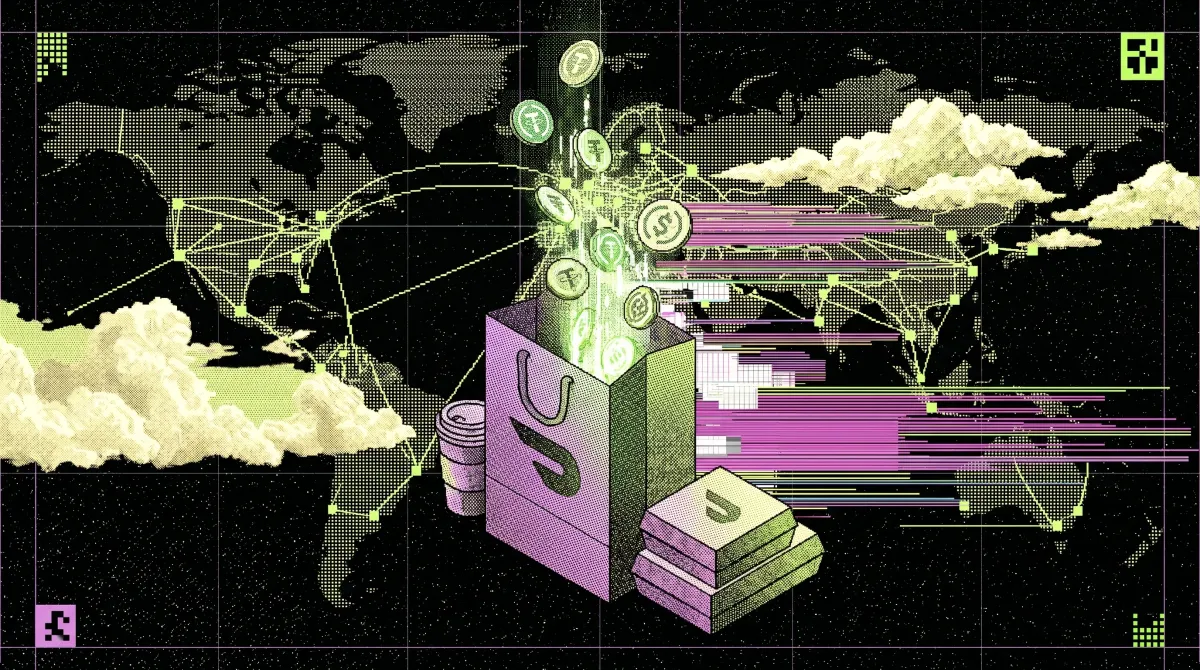
DoorDash is integrating stablecoin payments for merchants and delivery drivers across more than 40 countries through Tempo, a payments-first blockchain incubated by Stripe and Paradigm. It is one of the largest consumer platforms to move stablecoin rails into its core payment operations.
Quick Insights
- DoorDash is building stablecoin payment infrastructure on Tempo, a blockchain incubated by Stripe and Paradigm, for use across more than 40 countries.
- The integration targets merchant payouts and Dasher disbursements first, with cross-border flows where settlement speed and cost create the most friction.
- Stripe, Coastal Bank, and Latin American fintech ARQ are also moving payment operations onto Tempo's network, announced on the same day.
- Mastercard acquired stablecoin infrastructure firm BVNK for a reported $1.8 billion in March, while Visa expanded its stablecoin settlement platform in July 2025.
DoorDash is integrating stablecoin-powered payment infrastructure built on Tempo, a payments-first blockchain developed by Stripe and Paradigm, to speed up payouts to its merchants and delivery drivers across more than 40 countries. Tempo disclosed the partnership on Tuesday as part of a wider announcement that Stripe, Coastal Bank, and Latin American fintech ARQ are also bringing payment operations onto its network.
For DoorDash, which processed 903 million orders worth $29.7 billion in Q4 2025 alone, the appeal is straightforward. Its three-sided marketplace — consumers, merchants, and drivers — operates across dozens of countries, each with different payment rails, FX dynamics, settlement timelines, and compliance requirements. Stablecoin infrastructure, in theory, collapses that complexity into a single settlement layer.
"If we can get merchants and Dashers their money faster, and do that in a way that's affordable for them, that's a no-brainer for the entire ecosystem."
What Tempo Is and Why It Was Built for This
Tempo was purpose-built for payment workloads by Stripe and Paradigm, announced in September 2025, and went live last month with infrastructure partners including Mastercard, UBS, Klarna, and Visa. The chain handles over 100,000 transactions per second with sub-second finality, charges fixed fees denominated in stablecoins rather than a volatile native token, and offers private transaction channels designed for enterprise use.
That architecture is a deliberate contrast to existing networks. General-purpose blockchains face congestion, unpredictable costs, and infrastructure built primarily for trading and DeFi. Tempo's payment lanes reserve blockspace specifically for payment transactions, isolating them from network spikes and targeting a cost of roughly $0.001 per transaction.
Paradigm co-founder Matt Huang, who leads Tempo, described the project at launch as addressing a gap in the crypto stack: most of the infrastructure that exists was built for trading, not for moving money. DoorDash's scale, and the complexity of paying contractors and merchants across multiple currencies and jurisdictions, is exactly the kind of use case Tempo was designed to absorb.
— Tempo (@tempo) April 21, 2026
Traditional Finance Is Moving Fast in the Same Direction
DoorDash's integration lands against a backdrop of accelerating stablecoin adoption across mainstream financial infrastructure.
Stripe acquired stablecoin infrastructure firm Bridge for $1.1 billion in 2024 before co-developing Tempo. Mastercard agreed in March 2026 to acquire stablecoin infrastructure company BVNK for a reported $1.8 billion. Visa expanded its stablecoin settlement platform in July 2025. Nasdaq, Cboe, and CME Group are all building or filing for prediction and event-market products that depend on similar rails.
Nasdaq's MRX options exchange filing for binary-style contracts, Charles Schwab and Citadel Securities weighing entry into prediction markets, and now DoorDash moving stablecoin rails into daily payout flows all point to the same shift: regulated capital is moving from evaluating stablecoins to deploying them. That is a different moment from where the industry was even 18 months ago.
For a broader look at how stablecoin regulation is evolving across the US, EU, and UK to accommodate this shift, see our complete guide to stablecoin regulation in 2026.
The Practical Stakes for Merchants and Drivers
The DoorDash integration is not, at this stage, asking anyone to hold or speculate on stablecoins. The use case is purely operational: faster and cheaper disbursement of money that already exists. Merchants get paid out sooner. Drivers receive earnings with lower friction across borders. The stablecoin is a settlement mechanism, not an investment.
That distinction matters for adoption. When DoorDash positions this as infrastructure rather than a product feature, it sidesteps the consumer education problem that has slowed crypto payment adoption in the past. A merchant in Mexico or a driver in Brazil does not need to understand blockchain to benefit from faster settlement. They just need to see the money arrive.
Paradigm declined to give an exact timeline for when payments will go live at DoorDash. The company said it will start with merchant payout flows where the speed and cost benefits are most visible. Driver disbursements and broader consumer-facing features appear to be a later stage. DoorDash is due to report Q1 2026 results on 6 May, which may offer further detail on the integration's scope and timeline.


