The Race to Put the World's Assets on a Blockchain

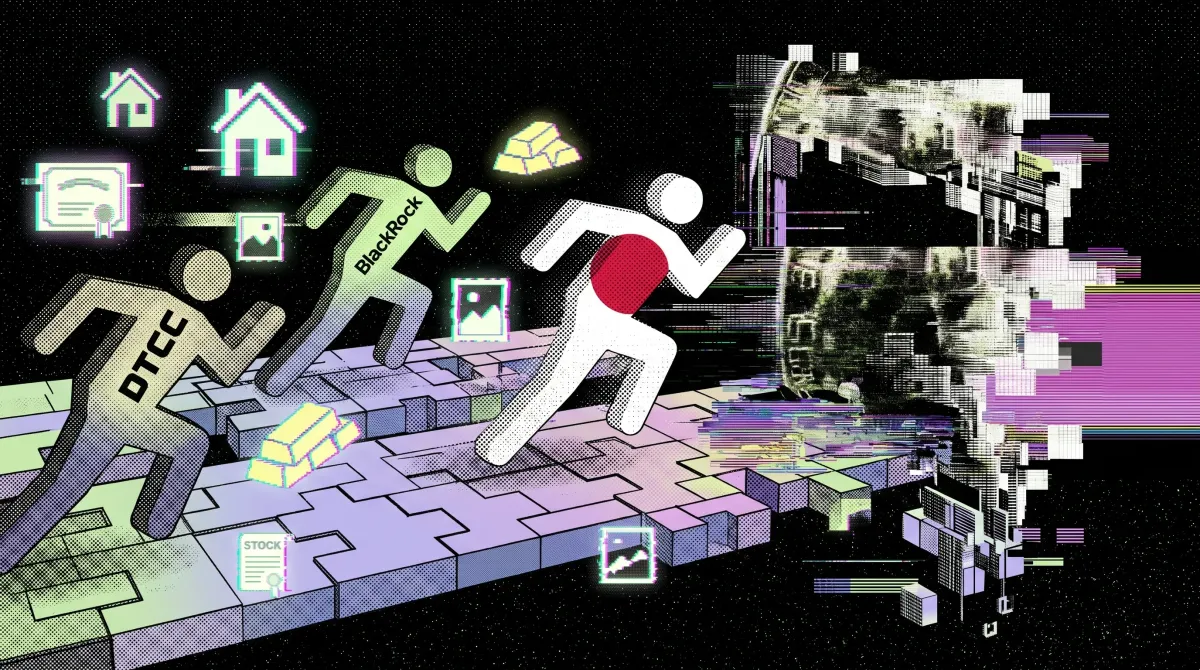
Tokenization is the process of putting ownership of real-world assets on a blockchain. It is no longer an experiment. Governments, central banks and the world's biggest asset managers are all building it now, and the market has grown 300% in a year.
Quick Insights
- Tokenization converts ownership of real-world assets into digital tokens on a blockchain, making them tradeable, programmable and accessible around the clock.
- The on-chain real-world asset market excluding stablecoins reached approximately $26 billion in early 2026, up roughly 300% from a year earlier.
- Japan, the US, Singapore, Hong Kong and the EU have all launched active regulatory frameworks or government-backed pilots for tokenized assets.
- Tokenized US Treasuries crossed $12.88 billion on-chain by early April 2026, with BlackRock, JPMorgan, Goldman Sachs and Franklin Templeton among the issuers.
Tokenization has become one of the most repeated words in institutional finance. Japan launched a blockchain pilot for its $7.5 trillion government bond market. BlackRock's tokenized money market fund passed $2 billion in assets. The IMF published a note in April 2026 calling it a fundamental reconfiguration of financial architecture. Singapore, Hong Kong, the EU and the US have all built regulatory frameworks around it.
The word gets used a lot, but what it actually means and why it matters gets explained less often. This guide covers both.
A Token Is Just Ownership Recorded Somewhere That Never Closes
Tokenization is the process of representing ownership of a real-world asset as a digital token on a blockchain. The asset itself does not move or change. What changes is how ownership is recorded, transferred and managed.
The simplest way to understand it is through an example. A commercial building worth $10 million could be divided into 10,000 digital tokens, each representing a $1,000 share. An investor who cannot afford the whole building can buy one token, hold it, earn a proportional share of rental income distributed automatically through a smart contract, and sell it to another investor at any time of day without a broker or a notary. The blockchain acts as the shared ledger that records who owns what and processes transfers without a central administrator.
The same logic applies to government bonds, company shares, private credit, gold, real estate, invoices and any other asset where ownership can be legally defined. Once the ownership right is represented as a token, it inherits the properties of the blockchain it sits on: it can settle in seconds, move across borders without correspondent banks, be used as collateral programmatically and trade around the clock.
Regulators Blinked First and $26 Billion Followed
The tokenized real-world asset market excluding stablecoins grew from roughly $5 billion in early 2025 to approximately $26 billion by early 2026, a 300% increase in twelve months. That growth reflects a convergence of forces that were not simultaneously in place before.
Regulatory clarity is the most important one. The US passed the GENIUS Act, establishing the first federal framework for stablecoins. The Clarity Act, which passed the House 294-134 in July 2025, is progressing through the Senate and would codify how digital assets are classified. In March 2026, the Federal Reserve, the OCC and the FDIC issued joint guidance confirming that tokenized securities receive the same capital treatment as their non-tokenized equivalents, removing a structural barrier that had kept many institutions on the sidelines. The SEC has also adopted a more collaborative posture, and in March it jointly named sixteen crypto assets as digital commodities alongside the CFTC.
Institutional infrastructure has matured in parallel. DTCC announced plans to tokenize US Treasuries on the Canton Network in December 2025. JPMorgan issued its deposit token natively on the same network from January 2026. BlackRock's BUIDL fund, JPMorgan's MONY fund launched with a $100 million seed, and similar products from Goldman Sachs and BNY Mellon are all competing in the same tokenized Treasury category. The infrastructure these institutions use is now production-grade rather than experimental.
From Tokyo to Brussels: No One Wants to Be Late to This
The geographic spread of activity is one of the clearest signals that tokenization has moved from niche to structural.
In Japan, Mizuho, Nomura and Japan Securities Clearing Corporation launched a Canton Network proof of concept in April 2026 to test Japanese government bond collateral on-chain, backed by the Financial Services Agency under its Payment Innovation Project. The trial runs through September 2026 and targets 24/7 real-time collateral settlement, which would be a significant upgrade from infrastructure currently constrained to business hours.
In the US, the DTCC tokenization service is moving toward production. Nasdaq has submitted filings to the SEC to bring assets on-chain and allow tokenized stocks and exchange-traded products to trade on blockchain rails. Securitize, a tokenization services provider, announced plans to list publicly on Nasdaq at a valuation of $1.25 billion.
Singapore's Monetary Authority launched Project Guardian as a public-private collaboration to test tokenized assets across multiple asset classes, and its BLOOM initiative has extended that work. Hong Kong's HKMA pushed its equivalent Project Ensemble beyond a sandbox environment into implementation in 2026. In Europe, Clearstream, which holds €20 trillion in assets under custody, launched a proprietary tokenization platform fully compliant with EU securities regulations, with commercial paper and medium-term notes as the first assets issued.
South Korea, the UAE, and several emerging markets are running parallel initiatives. The World Economic Forum noted in March 2026 that cross-border blockchain payments can settle near-instantly at up to 96% less cost than conventional methods, which is particularly significant for emerging markets where transaction costs and settlement delays impose real economic costs.
Settle in Seconds, Trade at 3am, Cut the Middlemen Out
The operational improvements tokenization delivers are specific and measurable. Settlement in traditional markets runs on a T+2 cycle, meaning a trade agreed today settles two business days later. Tokenized assets can settle in seconds. That compression reduces counterparty risk, frees up capital that would otherwise be tied up waiting for settlement, and removes the cut-off times that mean a trade placed late on a Friday might not settle until Monday.
Collateral management is another area where the gains are significant. JGBs, US Treasuries and other high-quality bonds are used extensively as collateral by institutional investors, but posting and substituting collateral today requires manual processes tied to business hours. When those bonds are tokenised and held on a blockchain, substitutions can happen in real time, at any hour, which keeps collateral working harder and reduces the cost of managing it.
Fractional ownership changes who can access certain asset classes. Private credit, real estate and private equity have historically required large minimum investments that put them out of reach for most investors. Tokenization allows those assets to be divided into smaller units and distributed to a wider investor base through compliant platforms, without the administrative overhead of traditional fund structures.
Programmability is the most underappreciated feature. Smart contracts can automate interest payments, enforce compliance rules, distribute dividends, and execute collateral substitutions without human intervention. That reduces operational costs and the scope for errors, and it allows assets to interact directly with DeFi protocols that would otherwise have no access to regulated, yield-bearing instruments.
The One Thing Tokenization Has Not Solved Yet
The growth numbers are real, but analysts tracking the market closely point to a gap between issuance and trading. Most tokenized assets are currently held rather than traded. Secondary market volumes remain low relative to the total value of assets on-chain, which means tokenization has so far been more successful at digitizing already-liquid assets like Treasuries than at genuinely unlocking liquidity in illiquid asset classes like real estate or fine art.
That is not a fatal flaw, it is a stage of development. The institutions building infrastructure now are doing it at the issuance and settlement layer. Secondary market depth tends to follow once the underlying infrastructure is reliable and the regulatory framework is clear. The regulatory picture is becoming clearer across most major markets, and institutional confidence is rising. Standard Chartered CEO Bill Winters put the longer-term view simply: pretty much all transactions will eventually be tokenized.
The more immediate signal to watch is whether central banks begin accepting tokenized assets as collateral in repo markets. Several have been assessing this through 2025 and 2026. The moment any major central bank formally accepts tokenized Treasuries or money market fund shares as eligible collateral, the institutional demand curve shifts sharply upward and the case for holding non-tokenized equivalents weakens.
Tokenization does not need a speculative thesis. The operational advantages are available now, the regulatory frameworks are being built, and the institutions with the capital to move markets are already moving. The question is no longer whether financial assets will move on-chain. It is how quickly the infrastructure catches up with the ambition.


